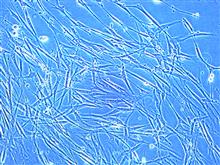
Our current research focuses on understanding the mechanisms of cellular response to oxidative stress, particularly when it leads to a disease known as idiopathic pulmonary fibrosis. The fibroblast is a cell that is a normal part of the connective tissue that is involved in tissue maintenance and also repair after injury. The activated form of these cells takes on a unique phenotype characterized by the appearance of muscle fibers, hence the activated cells are known as myofibroblasts. The contractility afforded by the muscle fibers is what assists in closing a healing wound. The myofibroblast should undergo programmed cell death or revert back to a fibroblast once the repair job is complete. Sometimes, the myofibroblasts persist and this can lead to the overproduction of collagen, a major component of the extracellular matrix. The buildup of excess collagen is what leads to the hardening of an otherwise flexible tissue, also known as fibrosis.
We take a multidisciplinary approach to study key proteins involved in the transition from fibroblast to myofibroblast and back. Understanding how fibrosis occurs and progresses in the lung may help to understand how these processes occur in other cell types such as liver, heart, and kidney, and pave the way for new therapies for a currently untreatable disease.
We have also recently begun work to develop portable biosensing systems for environmental contaminants, such as arsenic.